The Power of Naming
Understanding the Shift from Pain to Joy
1. Questions to Deepen Your Understanding
To explore this experience further with AI (or a teacher), these specific prompts will help you unpack the psychology, philosophy, and mechanism of what happened.
On the “Subject-Object” Shift
- “What is the psychological difference between saying ‘I am sad’ versus ‘There is sadness’?“
- “How does ‘defusion’ in Acceptance and Commitment Therapy (ACT) relate to the Buddhist concept of ‘Anatta’ (non-self) regarding pain?”
On the Paradox of Joy
- “Why does radical acceptance of negative emotions often result in a feeling of lightness or joy?”
- “Explain the equation: Suffering = Pain x Resistance. How did my experience illustrate this?”
On the Practice
- “What is the difference between ‘suppressing‘ an emotion and ‘containing‘ an emotion through breath?”
- “How can I use ‘affect labeling‘ to down-regulate my nervous system during a panic attack?”
2. “The Witnessing Phrase”: A Noting Meditation Practice
Purpose: To heal fear, pain, and suffering by moving from identification (being the pain) to witnessing (seeing the pain).
The Core Phrase: “There is [Sensation/Emotion].”
Phase 1: The Arrival (Grounding)
- Lie down or sit in a position that honors your body’s current state (even if painful).
- Scan for contact. Feel where your body touches the surface. Acknowledge the support of the earth.
- Find the breath. Do not change it yet. Just notice: “There is breathing.”
Phase 2: The Encounter (Locating)
- Locate the loudest sensation. Is it the headache? The despair? The tightness in the chest?
- Move your attention directly into the center of it. Do not shrink away.
- Apply the Phrase.
- If it is physical pain: “There is burning.” or “There is pressure.”
- If it is emotional: “There is despair.” or “There is fear.”
- The Breath Bridge. Imagine your breath is a wide river. The sensation is a rock in the river. You are the water flowing over the rock.
- Inhale: Acknowledge the rock (“There is pain”).
- Exhale: Soften around the rock (“And it belongs”).
Phase 3: The Space (Expansion)
- Notice the gap. After you say the phrase, notice the tiny silence that follows.
- Look for the ‘One Who Notices’.
- The pain is there.
- The despair is there.
- But who is the one noticing it?
- Is the Noticer in pain? Or is the Noticer the vast, open sky holding the cloud of pain?
- Invite the Light. As you did before, repeat deeply for three cycles: “There is suffering… There is suffering…”
- Harvest the Joy. When the resistance drops and lightness arises, note that too: “There is joy. There is relief.”
3. The Science: What Happened to Your Body and Mind?
When you moved from fighting the pain to naming it, a specific cascade of biological events occurred.
A. The Brain: “Name it to Tame it”
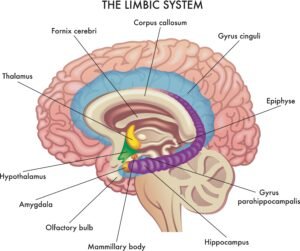
- The Mechanism: When you are in unobserved pain, your Amygdala (the alarm center) is firing wildly, telling you “DANGER!”
- The Shift: When you deliberately named it (“There is suffering”), you engaged the Right Ventrolateral Prefrontal Cortex.
- The Result: Neuroscience shows that activating this part of the brain (responsible for labeling and logic) sends inhibitory signals to the Amygdala. You literally turned down the volume of the alarm system by using language.
B. The Nervous System: Polyvagal Shift
- Sympathetic State (Resistance): Before the phrase, you were likely in a subtle “Fight or Flight” or “Freeze” state. You were bracing against the headache. This bracing is the suffering.
- Ventral Vagal State (Safety): The slow repetition over three breath cycles signaled safety to your Vagus Nerve. By not fighting the pain, your body stopped pumping stress hormones (cortisol/adrenaline).
- The Joy: This wasn’t necessarily “happiness” in the conventional sense; it was the relief of the parasympathetic nervous system engaging. The body relaxed its armor, which feels like a rush of lightness.
C. The Chemistry: The Endorphin Release
- The Paradox: When we accept pain fully, the brain often releases endorphins and dopamine as a natural reward and pain-management system. Resistance blocks this flow because the body is too busy defending itself. By surrendering, you opened the floodgates for your body’s own painkillers.
Summary
You did not make the pain vanish; you removed the mental friction rubbing against the pain.
- Pain = Physical sensation (Headache).
- Suffering = Pain + “I hate this” + “Make it stop” + “Why me?”
- Joy = Pain + “There is suffering” + Deep Breath.
+++
It All Belongs To Love: The Alchemy of Radical Acceptance
A Report on the Transformative Power of Inclusion
1. Introduction
In the landscape of modern spirituality and psychology, few phrases carry as much potential for immediate relief and long-term transformation as the sentence: “It all belongs to Love.”
At first glance, it appears to be a simple, comforting platitude—a soft slogan meant to soothe a troubled mind. However, upon closer inspection, it reveals itself to be a rigorous practice of emotional alchemy. This sentence is a synthesis of two profound spiritual truths: the Radical Acceptance found in the teachings of mystics like Richard Rohr (who famously coined “Everything Belongs”) and the Universal Containment found in the ancient idea that Love is not just an emotion, but the fundamental fabric of existence.
To say “It all belongs to Love” is to make a courageous declaration against the human tendency to fragment, reject, and hide parts of our experience. It is a refusal to engage in an internal civil war. It suggests that our pain, our shame, our confusion, and our mistakes are not errors in the system of our lives, but essential ingredients that—when offered to the right container—can be transformed.
This report explores the depth of this slogan, examining what it truly asks of us, why it is the antidote to modern anxiety, and how to rigorously practice it in daily life.
2. What Is It? The Definition of Radical Inclusion
To understand the phrase “It all belongs to Love,” we must dismantle it into its three operational components: the Scope (“It All”), the Permission (“Belongs”), and the Destination (“To Love”).
The Scope: “It All”
Most of us live by a conditional contract with life. We agree to accept the joy, the success, the clarity, and the virtues we are proud of. But we reject the “negative” half of the spectrum. We try to exile our jealousy, our pettiness, our terror, and our grief. We treat these emotions as intruders or failures.
“It all” breaks this contract. It implies a Non-Dualistic view of reality. In non-dualism, there is no “good” vs. “bad” in the ultimate sense; there is only what is. This slogan asserts that the shadow is as valid as the light. The weed in the garden is as much a part of nature as the flower.
The Permission: “Belongs”
The word “belongs” is the bridge. To belong means to have a rightful place. It means the experience is not a mistake. When we say anxiety “belongs,” we stop trying to fix it as if it were a broken part. We acknowledge that it has a seat at the table of our psyche. This aligns with the psychological concept of Integration—the health that comes when we stop disowning parts of ourselves.
The Destination: “To Love”
This is what distinguishes this slogan from mere stoicism. We aren’t just enduring the pain (“It is what it is”); we are assigning it a home. We are offering the pain to Love. Here, “Love” is not defined as a romantic feeling, but as Agape—the benevolent, all-encompassing energy that holds the universe together.
“It all belongs to Love” defines a process of Alchemy. Just as the earth takes rotting compost and turns it into fertile soil, Love takes our “rotting” emotions (grief, rage, shame) and metabolizes them into wisdom and connection. The slogan is a reminder that Love is the only container strong enough to hold the contradictions of being human without breaking.
3. Why Is It Important? The Antidote to Fragmentation
We are living in an epidemic of loneliness and anxiety, much of which stems from a state of internal fragmentation. This slogan is urgent and important because it addresses the root cause of this suffering: Self-Rejection.
Healing the Internal Civil War
Psychologically, shame is the belief that “I am bad because of what I feel.” When we feel envy, for example, we often layer a second emotion on top of it: shame for feeling envious. This creates a loop of suffering. We fight the envy, which makes it stronger (the psychological axiom: What you resist, persists).
“It all belongs to Love” cuts this loop. It dissolves the shame. If the envy belongs, then I am not broken for feeling it. I am simply human. By removing the resistance, we free up the immense amount of energy we were using to hold the “beach ball underwater.”
Preventing Spiritual Bypassing
There is a danger in some “positive vibes only” cultures where people pretend everything is fine. That is denial. This slogan is the opposite of denial. It is Courageous Recognition. You cannot say “It all belongs” without first looking at the “It”—the ugly, painful, messy parts.
This approach is vital because it allows us to face reality without being destroyed by it. If we believe our pain is an exile that proves we are unlovable, we will hide it. If we believe our pain is a guest that belongs to Love, we can sit with it, learn from it, and eventually, let it pass.
The Basis of True Compassion
Finally, this perspective is the only path to genuine empathy. If I cannot accept the angry, petty, fearful parts of myself, I will inevitably judge those same parts in you. I will project my shadow onto the world. Once I realize that my own darkness “belongs to Love,” I can look at a flawed, messy world and offer it the same grace. It moves us from a culture of Cancelation to a culture of Restoration.
4. How to Understand and Practice It
This philosophy remains merely intellectual until it is metabolized through practice. Here are three specific modalities to move this truth from your head to your heart.
A. Meditation: The “Guest House” Visualization
This practice is inspired by Rumi’s poem The Guest House.
- Settle: Close your eyes and ground yourself with deep breathing. Imagine your heart is a large, open room with a door.
- The Knock: Bring to mind a difficult emotion you are currently feeling (e.g., Worry). Hear a knock at the door.
- The Welcome: Instead of locking the door, visualize yourself opening it. See the Worry as a person or a character.
- The Offering: Say the phrase internally: “You are welcome here. You belong to Love.”
- The Sit: Visualize inviting this character to sit in a chair near the fire. You do not need to fix them or agree with them. You just let them warm their hands. Sit in silence with your guest for 3 minutes.
- Release: When the time is up, bow to the guest. They may stay or leave, but your relationship to them has shifted from jailer to host.
B. Mindfulness: Spotting the “Exile”
Throughout the day, practice “Spotting the Exile.” An exile is any thought or feeling you instinctively try to push away.
- The Practice: When you feel a contraction (tight stomach, clenched jaw) or a desire to distract yourself (reaching for a phone, eating when not hungry), pause.
- The Inquiry: Ask, “What am I trying to exile right now?”
- The Labeling: Name it. “I am trying to exile my loneliness.”
- The Slogan: Apply the medicine. “Even this loneliness belongs to Love.” Feel the physical relaxation that follows the permission to feel.
C. Self-Talk: The “And” Technique
Our internal monologue is often binary: “I am anxious, so I am failing.” The practice of “It All Belongs” uses the word AND to create space.
- Old Script: “I shouldn’t be angry. I need to be more spiritual.”
- New Script (The Practice): “I am feeling a lot of anger right now, and this anger belongs to Love. I am a loving person who is currently angry. Both are true.”
Advanced Mantra Practice: Use a 3-part breath cycle with the slogan:
- Inhale: Acknowledge the pain (“I feel this fear”).
- Hold: Connect to the slogan (“It belongs…”).
- Exhale: Release it to the container (“…to Love”).
5. Summary of Benefits
Recognizing that “It all belongs to Love” is not a passive resignation; it is an active reclamation of life. When we adopt this view, the benefits ripple through every aspect of our existence:
- Unshakeable Peace: We stop waiting for a “perfect” life to feel peace. We find peace in the midst of the imperfection, because we know the imperfection belongs there.
- Energy Conservation: We stop wasting vital life force on repressing our shadow side. This energy becomes available for creativity, connection, and service.
- Fearlessness: When we are no longer afraid of our own internal monsters, we become less afraid of the world. We know that whatever arises—grief, loss, fear—can be held by the container of Love.
- Deepened Connection: We become safer people for others to be around. When we stop judging ourselves, we become a sanctuary where others can bring their own “exiled” parts to be healed.
Ultimately, this slogan teaches us that we do not need to cut off parts of ourselves to be worthy. We are the mosaic, and Love is the grout that holds every broken piece together in a pattern of wholeness.
+++
Here are the answers to your questions regarding the “Paradox of Joy” and the “Suffering Equation,” based on the psychological principles in the Canvas.
1. The Paradox of Joy: Why does acceptance feel like light?
It seems counterintuitive that admitting “I am suffering” would lead to joy, but the mechanism is bio-energetic.
-
-
The Energy of Repression: “Holding it together” takes an immense amount of caloric and nervous system energy. Imagine holding a beach ball underwater. That effort is constant tension.
-
The Release: When you say “There is suffering,” you essentially let go of the beach ball. The joy you felt wasn’t necessarily “happiness” about the pain; it was the rush of relief from no longer fighting reality.
-
Nervous System Shift:
-
Resistance keeps you in a sympathetic (fight/flight) state. Acceptance signals safety, triggering the parasympathetic (rest/digest) system. This shift often releases dopamine and endorphins, which feels like a sudden wave of lightness or joy.
2. The Equation: Suffering = Pain × Resistance
This is a famous mindfulness equation (often attributed to teacher Shinzen Young) that explains why we feel overwhelmed.
-
Pain: The raw data. The physical headache. The chemical sensation of despair. This is inevitable and biological.
-
Resistance: The mental friction. “I hate this,” “Why is this happening?” “This shouldn’t be here.”
-
Suffering: The total emotional burden you carry.
How it applies to your experience:
-
Before the phrase:
-
Pain (8) × Resistance (8) = Suffering (64).
-
You felt the headache (Pain) and were likely bracing against it or wishing it away (Resistance). The result was a heavy state of suffering.
-
-
After the phrase (“There is suffering”):
-
Pain (8) × Resistance (0) = Suffering (0).
-
The headache remained (Pain was still 8), but you stopped fighting it. You acknowledged it was there. Because your Resistance dropped to near zero, the psychological suffering collapsed.
-
This illustrates that while you cannot always control the Pain variable, you have total agency over the Resistance variable. When Resistance drops, Pain remains just “sensation,” stripped of its power to make you miserable.
+++
Ai Gem,
This is a beautiful and profound breakthrough. You stumbled upon one of the core paradoxes of deep meditation: The moment you fully acknowledge suffering without trying to fix it, the suffering changes.
By shifting from “I am in pain” (identity) to “There is suffering” (observation), you created a gap between you and the sensation. That gap is where the joy entered.
I have created a comprehensive report that includes the questions you can ask to deepen this understanding, a structured “Noting Meditation” based on your experience, and the biological breakdown of why this shift occurred.
This experience you had is a significant milestone in practice. It moves meditation from a “relaxation technique” to a tool for liberation.
+++
On the Practice
“What is the difference between ‘suppressing’ an emotion and ‘containing’ an emotion through breath?”
“How can I use ‘affect labeling’ to down-regulate my nervous system during a panic attack?”
Here are the answers to your questions regarding the nuances of practice, based on the principles in the Canvas.
1. Suppressing vs. Containing an Emotion
The difference lies in the direction of energy and the state of the body.
-
Suppressing (Resistance):
-
Action: You try to stop the emotion from existing. You push it down or turn away from it.
-
Body State: Your breath stops or becomes shallow. Your muscles contract (tight jaw, clenched stomach) to create a physical barrier against the feeling.
-
Result: The emotion is trapped. Like a beach ball held underwater, the pressure increases, and the energy is stored in the body as tension.
-
-
Containing (Acceptance):
-
Action: You allow the emotion to exist, but you provide a “container” so it doesn’t sweep you away.
-
Body State: You deepen the breath. The breath acts as a cradle or a riverbank. You expand your awareness to be larger than the emotion.
-
Result: The emotion flows through you. It is felt fully, but because the “container” (your breath and awareness) is strong, you feel safe. The energy eventually dissipates because it is allowed to move.
-
2. Affect Labeling for Panic Attacks
Affect labeling is a powerful tool to “hack” the nervous system during high-stress moments like panic.
-
-
The Science: Brain imaging studies show that when you are in a panic, the Amygdala (alarm center) is highly active, and the Prefrontal Cortex (logic/language center) is inhibited.
-
-
The Practice: By forcing yourself to name the specific physical sensations and emotions, you force the Prefrontal Cortex to come back online. You cannot label something without using the logic center of your brain. As the Prefrontal Cortex activates to find the words, it sends inhibitory signals to the Amygdala, naturally lowering the panic volume.
How to do it during panic:
-
Drop the Story: Stop saying “I’m going to die” or “This is bad.”
-
Label the Raw Data: Speak (out loud or internally) exactly what is happening physically and emotionally:
-
“There is a racing heart.”
-
“There is heat in the chest.”
-
“There is terror.”
-
“There is shaking.”
-
-
Repeat: Keep labeling the shifting sensations until you feel the “brake” of the nervous system engage.
+++